Care & Display
How to Care for Acrylic and Mixed-Media Paintings in Dubai’s Heat and Humidity
By Radka Gicheva, abstract artist in Dubai · · 9 min read
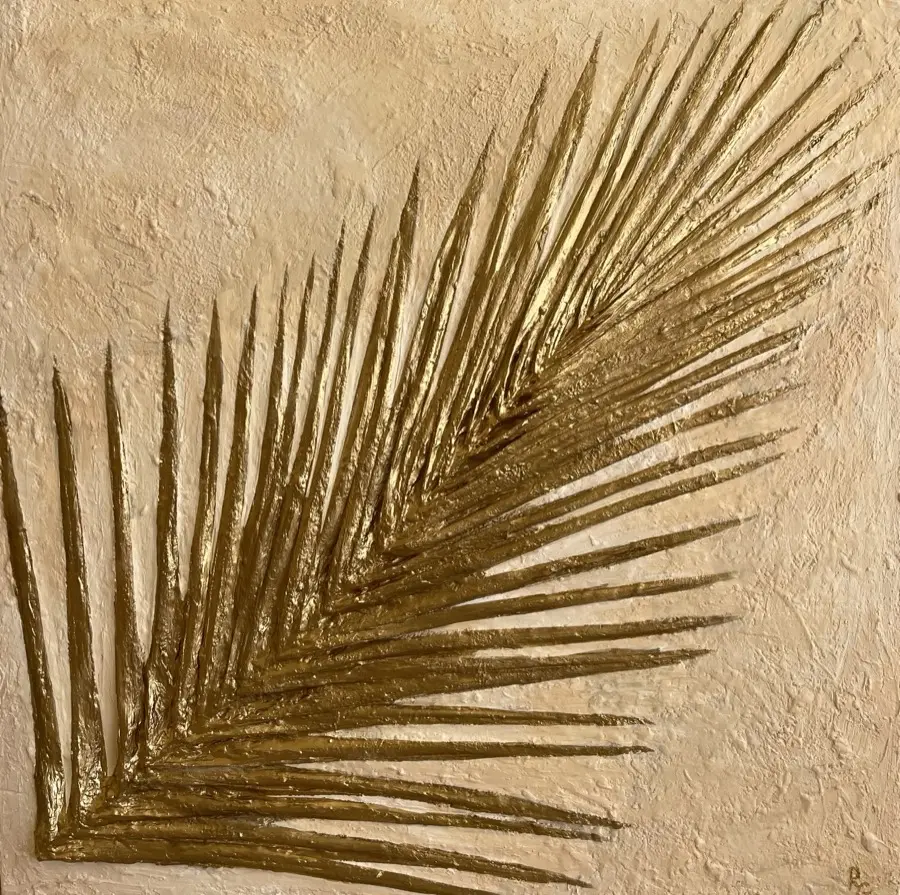
Most of the questions I get after a painting leaves my studio are about the climate, not the colours. Collectors want to know how to care for acrylic paintings in a humid climate like Dubai’s: will the varnish survive the summer, will the air conditioning crack the paint, and is it safe to dust a surface with fabric and plaster in it. This post puts the answers in one place.
I paint in acrylics, inks and soft and oil pastels over gesso, and I build texture with recycled materials, fabrics and everyday household items. That is what gives my mixed-media work its depth. None of it is difficult to look after. It comes down to where you hang the painting and a short list of things never to do to it.
Everything here applies to the pieces in my abstract collection and to commissions. If in doubt, ask me first; a photo is cheaper than a repair.
What Dubai does to a painting
A painting is a stack of organic materials, and Dubai gives it four things to cope with.
None of these will ruin a painting in a season. Over years they add up, and the difference between a work that still looks fresh and one that looks tired is almost always placement.
- Summer humidity. From early summer well into September the air is heavy and damp, especially near the coast. Canvas fibres take up moisture and relax, which is why a tight canvas can feel slightly slack by August.
- Air-conditioning cycling. Cooling dries the air sharply, then the room warms and dampens again when the unit switches off. A steady room is far kinder than one that swings between chilled and off.
- Dust. Fine desert dust gets everywhere and is slightly abrasive. On a textured surface it settles into every ridge.
- Sun through glass. Light through floor-to-ceiling glass is intense, and direct sun fades pigment, particularly inks and pastels, and heats the surface enough to soften varnish.
How my paintings are built to cope
I have been a member of the Dubai International Art Centre since May 2017, and my process has adapted to this climate. The full build is in how my textured paintings are made; here is the short version as it relates to care.
The same build goes into commissioned pieces, which also arrive signed front and back with a Certificate of Authenticity.
- Gesso first, then acrylic. Acrylic dries to a flexible film that bonds well to gesso and tolerates humidity better than most traditional media.
- Texture that is sealed in. Plaster, fabric and found materials are bedded into acrylic and painted over, so nothing sits loose on the surface. Arabian Beauty, 80 × 80 cm, is built up in acrylic and plaster and, at 4 cm, is as deep as any canvas in my textured collection.
- Two coats of varnish. The varnish seals the acrylic and pastel passages, evens out the sheen and gives a barrier against UV and dust.
- Signed front and back. The reverse signature stays with the canvas even if a frame later covers part of the front edge.
Where to hang, and where not to
Placement does more for a painting than any cleaning routine. In a Dubai home I would avoid the following, in rough order of how much damage they do.
Good positions are walls that stay in shade for most of the day: a hallway, the wall beside rather than opposite a large window, a bedroom, a home office.
- Directly under or in front of an AC vent. The cold, dry stream hits one part of the canvas while the rest stays warmer, which is the fastest route to a rippled corner.
- Facing west-facing glass without curtains or film. Afternoon sun is the harshest light a painting will see indoors.
- Kitchens. Cooking vapour leaves a film of grease on varnish that cannot be removed without solvents.
- Bathrooms. Steam and humidity swings are exactly what canvas and paper dislike most.
- Exterior walls that feel warm in summer. The painting on such a wall is baking on one side and chilled on the other.
Dusting textured and fabric-inlaid surfaces
This is where most people go wrong. A textured mixed-media surface has ridges, fabric edges and pastel passages that a cloth will catch and a spray will stain.
- Use a large, soft, dry brush and work from the top down. A clean make-up powder brush or a soft goat-hair brush is ideal. Light downward strokes. Every month or two is plenty; check after a sandstorm.
- Never use wet wipes, household sprays, furniture polish or glass cleaner on the painted surface. They leave residue on varnish and some soften it.
- Works on paper are framed and shallow. My paper pieces are 0.1 to 0.2 cm deep and always sold framed: Abstract N9, Illusions In Blue I and Mixosso N1 are all around 42 × 30 cm. If the frame has glazing, wipe the glazing with a barely damp microfibre cloth, spraying the cloth and never the glass, and leave the artwork alone.
- Stretched canvases are up to 4 cm deep. Dust the edges as well as the face.
- Pastel and charcoal passages want the lightest touch. Mysterious Faces, 60 × 70 cm, has charcoal and pastel drawing in it. The varnish seals them, but do not rub. Brush once, lightly, and stop.
Leaving Dubai for the summer
Many of my collectors leave for July and August. Do not switch everything off before locking the door: a sealed flat with no cooling becomes hot and humid within days and stays that way for weeks.
Keep the air conditioning on a moderate set-point rather than off. Mid-twenties Celsius is plenty; you are keeping the air dry and steady, not cooling for comfort. Draw the curtains on any window that gets direct sun, and ask whoever waters the plants to send you a photo of the paintings.
Storing or moving a painting
Paintings travel badly when rushed. If you are moving house, renovating or storing a piece for a while, use the same materials I use when I ship, all described on my shipping page.
Keep the packaging your painting arrived in. It is the right material and the right size, and you will need it if you ever return the work.
- Acid-free glassine against the surface first. Never put bubble wrap directly on the paint; in Dubai heat the bubbles can print a pattern into the varnish.
- Foam or cardboard corners, then a rigid box or crate. Anything around 80 cm and above is worth crating.
- Store upright, never flat under weight. Face to face or back to back if you have more than one, with a board between them.
- Never in a car boot in the heat. Even a short summer drive takes a boot far above any temperature a varnish should see.
- Never in a non-climatised storage unit. If the unit does not advertise climate control, assume it is an oven in summer.
Signs of trouble and what to do
Most problems announce themselves early. If you see any of these, send me two photos, one of the whole painting and one close-up, before you try anything yourself. Email or WhatsApp is fine.
- Tacky varnish. The surface feels slightly sticky on humid days. Move the painting to a cooler wall, keep everything off the surface and let it settle. If it has not recovered in a couple of weeks, contact me.
- Canvas slack. A little movement in August is seasonal and often tightens again in winter. If it stays slack, the wooden keys in the stretcher corners can be tapped out to restore tension; I can show you how.
- White bloom. A milky haze on the varnish, caused by moisture trapped under it. Do not polish it or apply anything. This one needs me to look at it.
- Frame gaps or a lifting corner on a work on paper. Paper responds to humidity more than canvas. Move the piece somewhere drier, and if it does not flatten, it needs reframing.
What returns do and do not cover
My return policy gives you 30 days from delivery to return an original for a full refund of the artwork price, provided it comes back in original condition, in its original or equivalent packaging, with the Certificate of Authenticity. Return shipping is at your cost unless the piece arrived damaged or defective.
Two exclusions matter here. Damage caused after delivery, including exposure to moisture, direct sunlight or improper hanging, is not covered, and commissioned pieces are made to order and cannot be returned. Damage in transit is different: every shipment is insured, so if a painting arrives damaged, photograph the packaging and the piece straight away and contact me within 48 hours for a replacement or full refund, including shipping.
Frequently Asked Questions
Does varnish yellow over time?
Modern acrylic varnishes are formulated to resist yellowing, and I apply two coats to every painting. The discolouration I see on older works comes from kitchen grease, smoke and direct sun, not the varnish.
Can I hang a painting in a bathroom with an extractor fan?
I would rather you did not. An extractor reduces steam but not the humidity swings, and a work on paper in particular will cockle. If you must, choose a small varnished canvas rather than paper and keep it well away from the shower.
How often should I dust a textured painting?
Every month or two with a soft, dry brush, working from the top down. Check more often after a sandstorm or if you live near construction.
Is textured art hard to keep clean?
No. It needs a different tool, a brush instead of a cloth, and no liquids at all. Two minutes every couple of months is all it takes.
Can acrylic paintings withstand humidity?
Yes. Once dry, acrylic stays flexible, so damp air on its own does little to it. The weak points are the canvas or paper underneath and anything left unvarnished, which is why my paintings get two coats and why steady air conditioning matters more than the paint.


