Studio & Process
How Textured Mixed-Media Paintings Are Made: Gesso, Palette Knife, Fabric and Recycled Materials
By Radka Gicheva, abstract artist in Dubai · · 9 min read
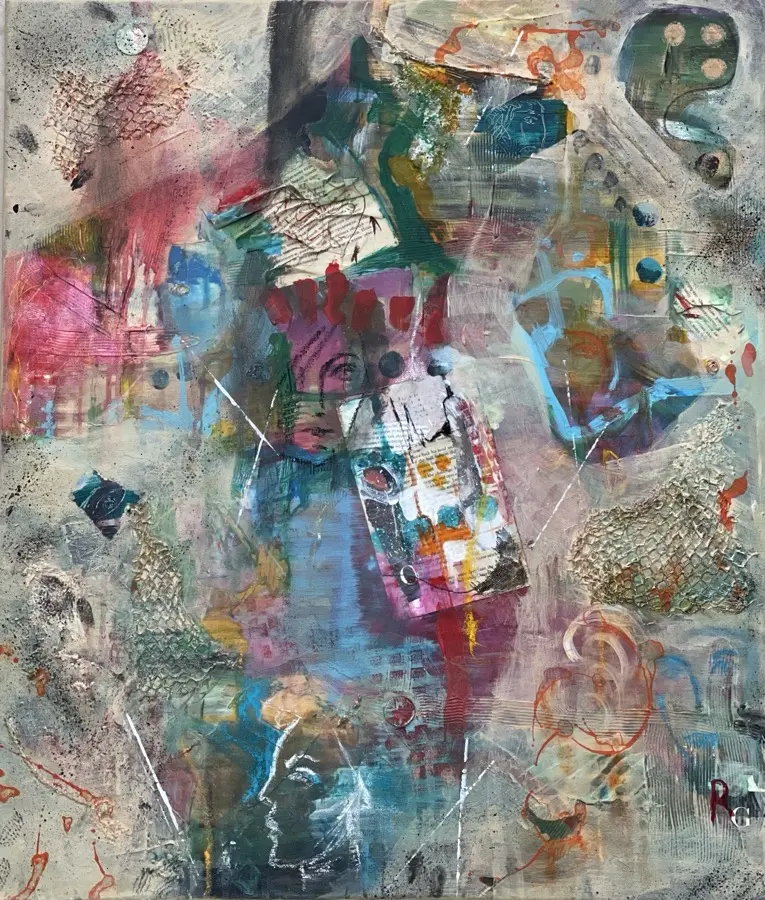
People ask me how textured paintings are made more than anything else. Usually the question comes in front of a piece like Mysterious Faces: they lean in, notice that the surface is not flat, and want to know what is under the paint. This is the answer I would give in the studio, layer by layer.
Almost everything in my abstract collection is listed as mixed media, and the surface is built rather than painted in one go. Gesso decides the relief. Acrylics, inks and pastels bring the colour. Fabric, recycled paper and household objects go in where the composition wants weight. Then come the exceptions: one palette knife oil, a canvas scraped back in a single session, and the drip paintings.
Textured, mixed media, palette knife, drip: what the listing terms mean
The terms overlap. Here is how I use them on this site.
- Textured describes the surface, not the materials: any relief you can see under a side light, whether from thick gesso, knife-applied paint or cloth under the colour. See the textured art page.
- Mixed media means more than one family of material on one surface. Mysterious Faces is catalogued as acrylic, charcoal, gesso, conté and pastel; the mixed media page goes deeper.
- Palette knife is a tool, but I use it as the label when the knife did the work. Only Coral and Blue carries it, and that piece is oil on canvas.
- Drip painting has its own section of the gallery: the paint is thrown or poured, and the texture is thin and glossy rather than built up.
Layer one: gesso, and why the ground decides the texture
Gesso is a white acrylic primer; I use it as a building material rather than a sealer. Applied thick and dragged, combed or pressed, it sets into ridges that every later layer has to negotiate. Thin paint pools in the valleys; a pastel stick touches only the peaks. That is why the first layer decides more than anything I do afterwards.
Abstract N9 is the clearest example online. Its listing says it plainly: several layers, the first made with gesso, the next mainly acrylic, with different materials added for unusual effects. It is a framed work on paper, 42 × 30 × 0.1 cm, $280.
Layer two: acrylics, inks and pastels in intuitive passes
My preferred mediums are acrylic paints, inks, and both soft and oil pastels. I work in passes: a thinned acrylic wash to tint the ground, opaque colour where shapes suggest themselves, ink where a line should run into the texture, pastel where a mark should sit on top rather than sink in. Each pass reacts to the one before.
Mysterious Faces (60 × 70 × 2 cm, $1,600, 2019) shows this stage. The faces were not planned; they emerged from mark-making in charcoal and conté over the gesso, and I followed them. Ancient Secrets (30 × 40 × 1 cm, $650) does the same on a much smaller surface, combining acrylic, ink, oil and pastel.
Layer three: fabric, recycled materials and household objects
This is what makes a painting mixed media rather than simply textured. Into the wet gesso, or between later paint layers, go the things I collect: offcuts of fabric, pages from old books, napkins, rope, sea shells, dried leaves. They come from around the house and from what would otherwise be thrown away.
Arabian Treasures (40 × 30 × 2 cm, $350) has sea shells and fabric in its gesso layer. Mysterious Faces N2 (70 × 60 × 3 cm, $1,500) combines gesso, recycled book pages and fabrics under the acrylic.
How they are secured matters more than what they are. Fabric pressed into gesso becomes part of the ground once it cures; paper and lighter objects are bonded with acrylic, painted over and varnished with the rest of the surface.
Palette knife and scraping back: two worked examples
Coral and Blue (50 × 50 × 2 cm, $300) is oil on canvas, painted in 2019, in the years I was taking oil classes at the Dubai International Art Centre. A knife does two things a brush cannot. It leaves a ridge with a sharp edge, so the paint casts a real shadow under side light, and it lays colours next to each other without blending them. Between the coral and the deep blue, small strokes of green, yellow, red, white and blue stay separate up close and mix in the eye from across the room. That is optical mixing.
My Soul — Abstract N23 (60 × 60 × 2 cm, $350, 2020) was made with acrylic, charcoal and spray paint, built up and scraped back until the right feeling emerged, every mark in a single session. Scraping back means dragging a blade across wet paint, taking the top layer off the ridges and leaving it in the hollows, so earlier colours reappear along the texture underneath. It has to happen in one sitting because acrylic sets quickly; once cured, scraping only scratches.
Drip and enamel: a different physics
Drip paintings are the exception. There is no gesso relief and nothing embedded; the canvas lies flat and the paint falls onto it. Neon Rhythm (30 × 40 × 2 cm, $200) is acrylic and enamel, made by throwing paint rather than brushing it. Whispers of Motion, now sold, was the large one: 200 × 120 × 4 cm, enamel and acrylic on stretched cotton canvas, $1,500, with black enamel lines across open space and splatters of yellow, orange and dark blue.
The paint is a liquid in flight, so its thickness decides whether it lands as a line, a bead or a spray, and the height and speed of the movement decide the shape. Enamel dries glossy and sits proud of the flatter acrylic, so in a room the painting reads as line and gloss rather than relief.
Depth: 0.1 cm works on paper versus 2 cm and 4 cm canvases
Depth on a listing is the thickness of the piece, and it tells you how the texture will behave on your wall.
- 0.1–0.2 cm: works on paper such as Abstract N9. They arrive framed, the relief is fine rather than sculptural, and they suit close viewing.
- 2 cm: the standard stretched canvas, including Mysterious Faces and My Soul. Deep enough to hang unframed with painted edges, slim enough for a floating frame.
- 3–4 cm: gallery-depth canvases such as Light in the Darkness (80 × 80 × 4 cm, $1,100) and Mysterious Faces N2 at 3 cm. The canvas itself casts a shadow, so the whole object reads as relief.
Finishing: signature, two coats of varnish, and light
Every painting is signed on the front and back and finished with two coats of varnish. On a textured surface varnish does more than protect: it evens the sheen between matte pastel and glossy acrylic and shields the ridges from dust and UV.
Morning light from the side makes every ridge visible, overhead light at midday flattens it, and a warm evening lamp picks out the peaks, so look at a piece under more than one light before deciding where it hangs. Strong window light and air conditioning are covered in caring for acrylic and mixed-media paintings in Dubai humidity.
Where I learned it: Plovdiv and the Dubai International Art Centre
I took art lessons at Studio Chaushev in the Old Town of Plovdiv, Bulgaria, from 2003 to 2006; a gypsum head drawing from 2004 still sits in my studies and sketches. In May 2017 I became a member of the Dubai International Art Centre and took its oil classes from 2017 to 2020, the background to the knife work in Coral and Blue. In 2019 I added the centre’s abstract and mixed media classes. More on my about page.
Commissioning a textured piece: what you can specify
Commissions start from about $600 (roughly AED 2,200) for a piece around 40 × 50 cm. A 50% deposit, by Stripe or bank transfer, secures the slot. Most pieces take 2–4 weeks; anything over 120 cm, or with heavy texture that needs long drying times between layers, takes 4–6 weeks. I send a progress photo midway, your chance to adjust colour or composition. Commissioned work is signed front and back, varnished twice and comes with a Certificate of Authenticity; being made to order, it cannot be returned.
Texture is decided in the first layer and cannot be added convincingly at the end, so agree it early. You can specify:
- Relief and materials: from a fine gesso skin to heavy knife-built ridges or plaster like Arabian Beauty (80 × 80 × 4 cm, $1,800), with fabric, paper, natural objects or none at all.
- Palette: built from your interior photos, fabric swatches or references, and refined together before I start.
- Format and depth: from about 30 × 40 cm to statement works over 150 cm, on a 2 cm or 4 cm stretcher depending on whether you plan to frame it.
Frequently Asked Questions
What is mixed media art made of?
In my case: a gesso ground, acrylic paints, inks, soft and oil pastels, charcoal or conté, and embedded materials such as fabric, recycled book pages, napkins, rope, sea shells or dried leaves, sealed under varnish. Each listing names the materials in that piece.
Is textured art durable?
Yes, when built properly. Gesso and acrylic cure into a tough, flexible film, embedded materials are fixed within it and painted over, and varnish protects against dust and UV. Keep it out of direct sun and off damp walls.
Does textured art collect dust?
Ridges hold a little more dust than a flat surface, but the varnish means it sits on top rather than in the paint. A soft, dry brush every few weeks is enough; never use water or cleaning sprays.
Why is mixed media sometimes priced higher than a plain acrylic canvas?
Time and material set the price, not the label. A heavily built surface means more gesso, more drying time and more sessions. Size matters more than medium: My Soul at 60 × 60 cm is $350, while the 4 cm deep, 80 × 80 cm Light in the Darkness is $1,100.
Can texture be matched to a fabric or rug?
Colour, yes: send a swatch or photo and I build the palette from it. Relief can echo the character of a textile, a fine weave or a coarse grain, but I would not copy a pattern. We agree the relief at the concept stage.


